
Curriculum
Generic Curriculum Intent
Nestled in the picturesque seaside town of Looe, our world-class curriculum proves that you don’t need to be big to think boldly.
Designed to spark curiosity, develop resilience and draw learners into a powerful state of flow, our approach weaves together knowledge, skills, and understanding in a way that’s both seamless and meaningful.
Here, learning is not just confined to subjects—it’s a dynamic, interconnected journey that empowers students to become ambitious, assessment-capable, culturally aware, and socially conscious global citizens.
We place high value on the foundational power of numeracy, literacy and oracy, recognising these as essential tools for communication, reasoning, and critical thinking, whilst embracing the theory that creativity and problem-solving are woven through all subjects, brought to life through meaningful synchronicity that deepens learning and connects ideas with purpose.
Grounded in the values of respect for self, others, and the environment, our learners are nurtured to become responsible with their confident voices for change—positive disruptors, game-changers, and active agents of a better future.
With a deep sense of place and a global perspective, we proudly live by our motto:
‘Be The Best You Can Be'
Curriculum Implementation
Curriculum Implementation Statement
Purpose
Our curriculum is implemented through consistent, research-informed classroom routines and adaptive teaching that enable all pupils—especially those with additional needs—to build secure knowledge over time, use ambitious vocabulary, and produce high-quality work. Implementation prioritises clarity, coherence and an environment of high challenge with low threat, where pupils think hard, feel safe to try, and are supported to succeed.
Core Implementation Principles
- Coherence and Sequencing
Units are sequenced so that new content builds on prior knowledge and is revisited through planned retrieval. Knowledge and skills progress cumulatively; the curriculum itself is the progression model. Lessons make this sequence explicit through outcomes, models, and routines that reduce cognitive load. - Ambition and Equity for All
Every pupil is entitled to a broad, demanding curriculum. Expectations are tiered through precise scaffolds and adaptive teaching, so pupils with SEND and those who are disadvantaged access the same ambitious content and achieve success. - Vocabulary Rich Instruction
Tier 2 and tier 3 vocabulary is explicitly taught (e.g., Frayer model) so pupils can think and communicate with precision. Reading and oracy are woven into subject sequences to deepen understanding and raise attainment. - High Challenge, Low Threat Culture
Teacher explanations and tasks stretch pupils just beyond current competence, while routines, modelling, and feedback normalise mistakes as part of learning. This promotes effort, persistence and quality outcomes. - Assessment for Curriculum
Formative assessment is embedded to check understanding, guide reteaching and secure long-term learning. Summative assessment samples the taught curriculum to evaluate how well pupils have learnt what was intended.
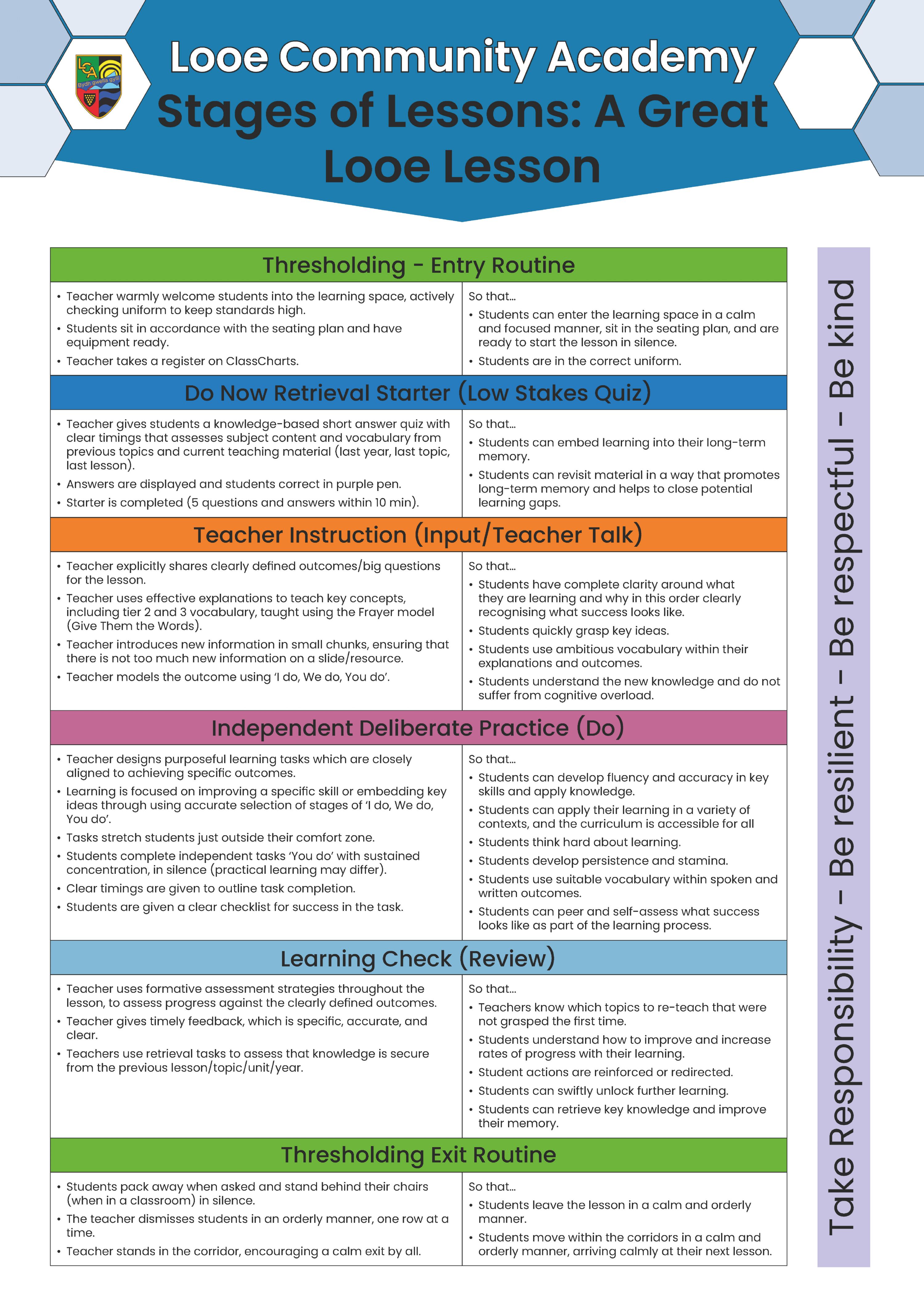
How Our Routines Deliver the Curriculum
Threshold: Entry and Exit
-
Implementation: Staff greet pupils with warmth, uphold uniform standards, and settle classes swiftly for calm starts and strong learning attention.
-
Curriculum Impact: Maximises available learning time and creates the calm conditions needed for focused explanation, modelling and practice; supports behaviour and safe movement between lessons.
Do Now: Low Stakes Retrieval (mixture of last year / topic / lesson)
-
Implementation: 5 short questions completed within 10 minutes; answers revealed and corrected in purple pen.
-
Curriculum Impact: Predictable and strengthens memory, surfaces misconceptions, and prepares pupils to connect new content to secure prior knowledge; informs immediate reteaching.
Teacher Instruction: Explain, Model, Rehearse
-
Implementation: Clear lesson outcomes and big questions; explicit vocabulary teaching; small chunks on slides; live modelling through I do → We do → You do and Guided practice.
-
Curriculum Impact: Reduces cognitive overload, clarifies success, and ensures pupils grasp concepts before independent work; promotes precise language use across subjects.
Independent Deliberate Practice
-
Implementation: Purposeful tasks aligned to outcomes; timed learning in some learning episodes (with variation in practical lessons); stretch just beyond comfort; success checklists enable self/peer assessment.
-
Curriculum Impact: Builds fluency and transfer, develops stamina, and makes success criteria visible, so pupils can judge quality and improve. The culture balances challenge with psychological safety.
Learning Check: Formative Assessment and Feedback
-
Implementation: Ongoing checks (questioning, mini whiteboards, warm - cold calling, exit prompts); timely, specific feedback; targeted retrieval to secure prior content.
-
Curriculum Impact: Teachers know what to reteach and when; pupils know how to improve and unlock further learning; leaders can judge whether pupils are learning the intended curriculum.
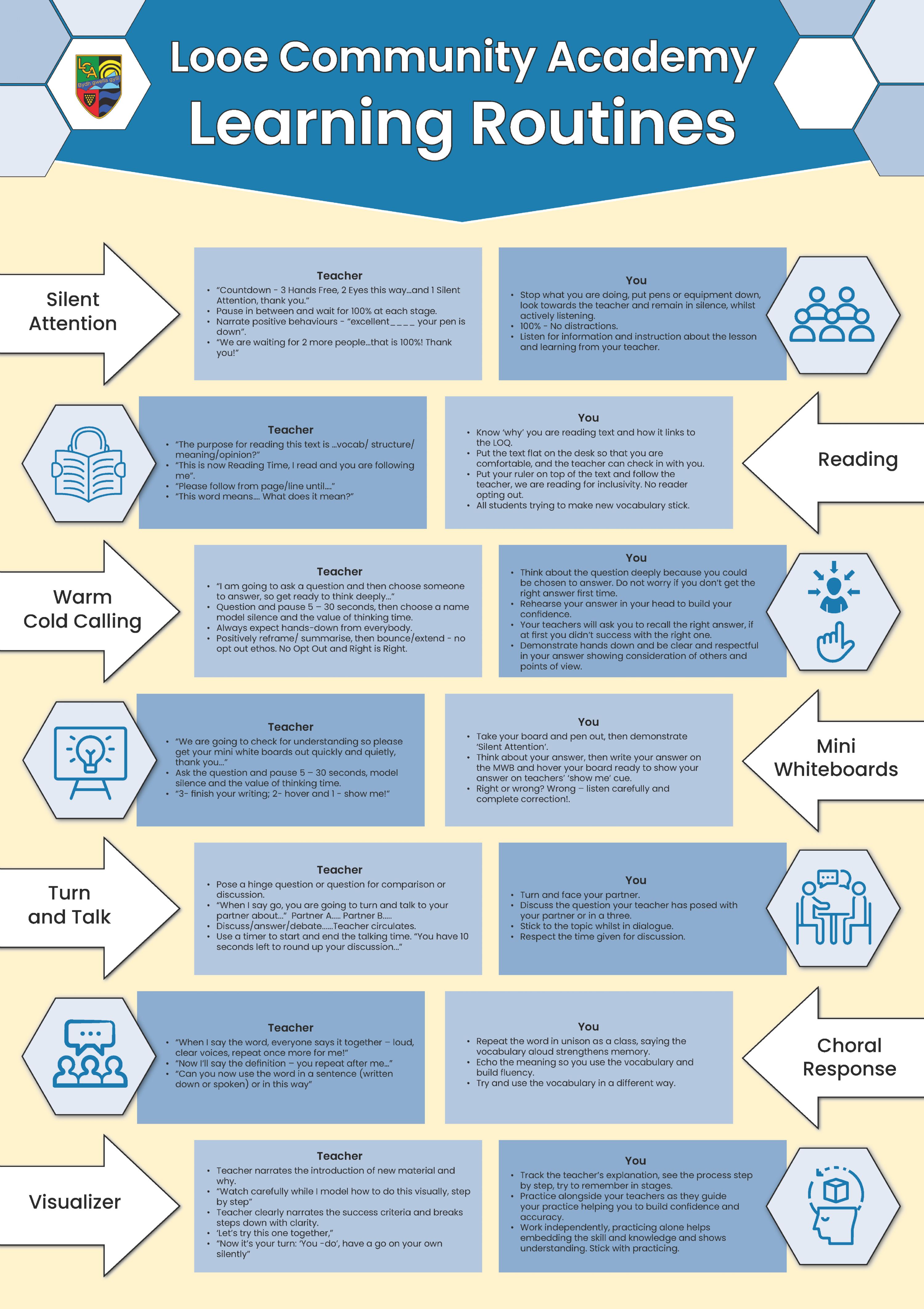
Shared Routines from the LCA Poster Set
-
Silent Attention, Warm Cold Calling, Turn and Talk, Choral Response, Reading, Mini Whiteboards Visualisers
These routines structure thinking, participation and checking for understanding. They support equity (everyone thinks/responds), strengthen oracy and literacy, and give immediate visibility of misconceptions, so the taught curriculum can be adjusted in the moment.
Why High Expectations and Ambition Matter at LCA
At Looe Community Academy, we believe that high expectations and ambition are non-negotiable for every student. They are the foundation of academic success and personal growth. Research demonstrates that teacher expectations significantly influence student achievement: “Students tend to achieve what teachers expect of them” (Rosenthal & Jacobson, 1968). When we set the bar high and communicate that excellence is possible for all, students rise to meet those challenges.
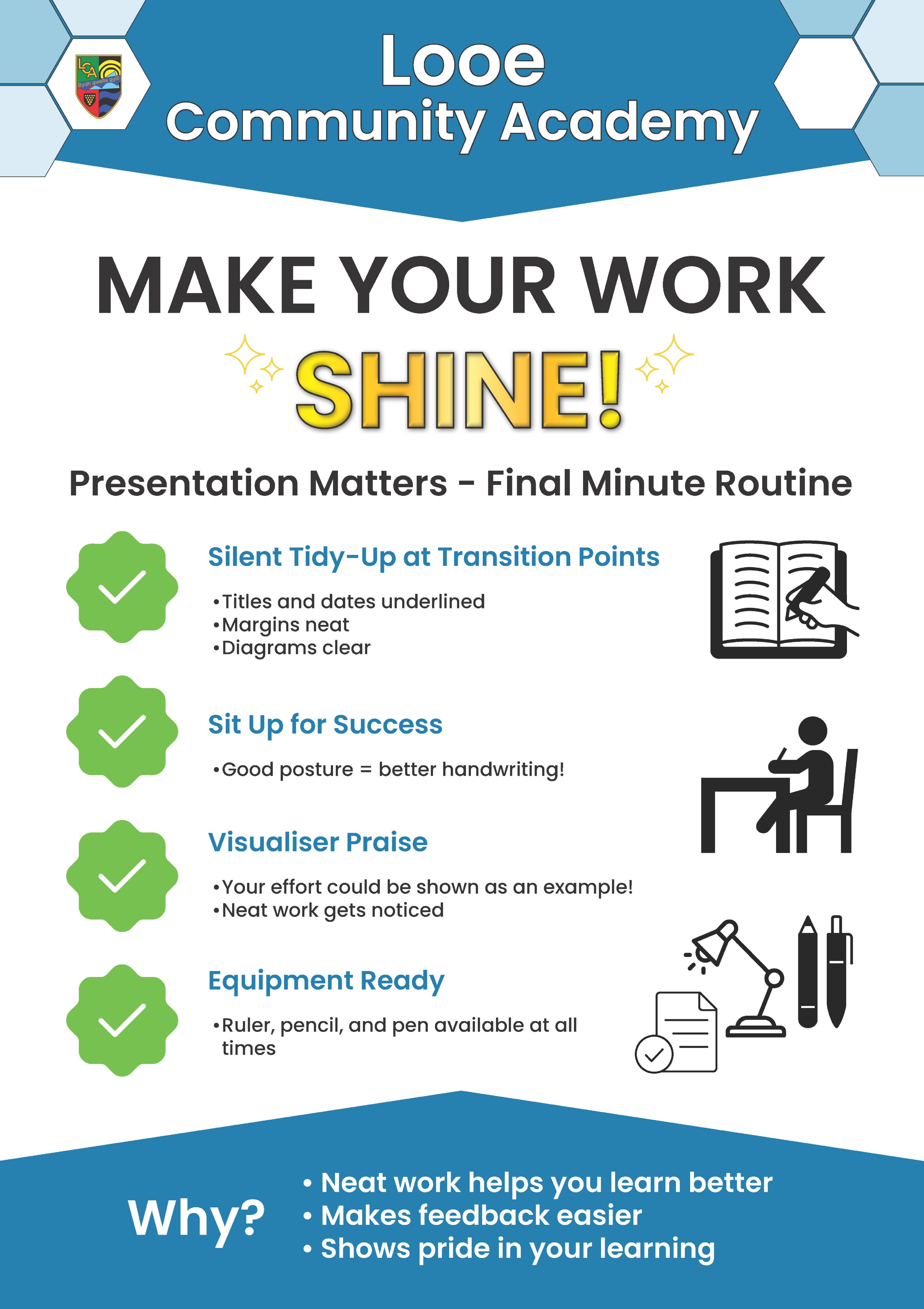
The Education Endowment Foundation (EEF) highlights those consistent routines and attention to detail—such as neat presentation, posture, and readiness—develop metacognitive habits and self-regulation, which are strongly linked to improved outcomes. These small but deliberate actions matter because they build discipline, pride, and resilience over time. As Mary Myatt asserts, “High challenge, low threat environments enable pupils to produce work of quality and depth” (High Challenge, Low Threat, 2016). By sweating the small stuff, we send a clear message: every detail counts, and every student is capable of excellence.
Our approach ensures that presentation standards, such as underlined titles, clear diagrams, and organised work, are not superficial—they are signals of ambition and respect for learning. These habits make feedback more effective, improve clarity of thought, and foster a culture where students take pride in their work. Ultimately, high expectations prepare students not only for examinations but for life beyond school, equipping them with the mindset and skills to thrive in further education and employment.
Professional Development and Consistency
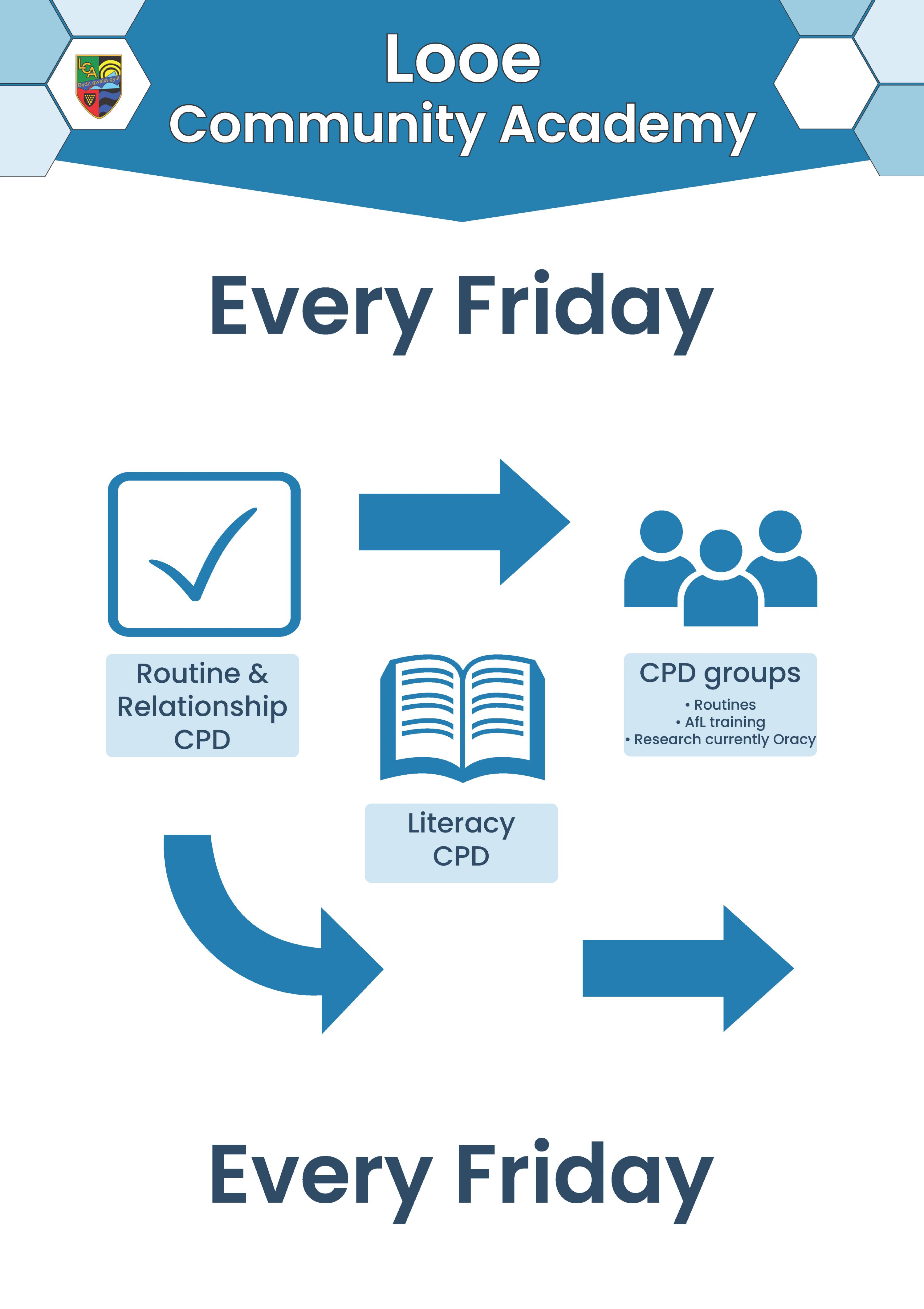
Staff training focused on spaced practice and structured through recap – model – practice. Friday morning CPD is led by expert teachers and follows the pattern of Routines → Literacy → CPD Groups. CPD Groups are split into: Routines & Relationships; Assessment for Learning and Research group – currently focusing on Oracy in the curriculum.
-
Staff are coached fortnightly through Step Lab led by two expert coaches and every member of the teaching team belong to a fluid CPD group.
-
Subject leaders oversee sequencing and ensure that lesson resources align with progression maps; curriculum design is live and evolving.
-
Drop-ins happen hourly and Step Lab coaching builds on our shared practice.
-
HODs and subject leaders look at what pupils have learnt, not just what was taught, and this is explored through quality assurance and challenge partners with outstanding schools.
Fortnightly Subject Breakdown
| Subject | KS3 | Subject | Year 10 | Subject | Year 11 | ||
|---|---|---|---|---|---|---|---|
| English | 8 | English | 8 | English | 8 | ||
| Maths | 8 | Maths | 8 | Maths | 8 | ||
| Science | 8 | Science | 8 | Science | 8 | ||
| Games | 4 | Games | 4 | Games | 4 | ||
| RE/PSHE | 2 | RE/PSHE | 2 | RE/PSHE | 2 | ||
| 30 | 30 | 30 | |||||
| History | 3 | History | option | History | |||
| Geography | 3 | Geography | A | 5 | Geography | 1 year option | 10 |
| MFL | 4 | MFL | B | 5 | MFL | ||
| Comp Sci | 2 | Comp Sci | C | 5 | Comp Sci | 2 year option A | 5 |
| Catering | 1 | Catering | D | 5 | Catering | 2 year option B | 5 |
| Textiles | 1 | Textiles | Textiles | ||||
| DT | 1 | DT | DT | ||||
| Art | 1 | Art | Art | ||||
| Dance | 1 | Dance | Dance | ||||
| Drama | 1 | Drama | Drama | ||||
| Music | 1 | Music | Music | ||||
| Oracy | 1 | Sociology | Film studies | ||||
| 20 | Engineering | 20 | Engineering | ||||
| Hospitality | Hospitality | ||||||
| Total hours per fortnight | 50 | 50 | 50 | ||||