English
When I read great literature, great drama, speeches, or sermons, I feel that the human mind has not achieved anything greater than the ability to share feelings and thoughts through language.
- James Earl Jones
English Curriculum Intent Statement
At Looe Community Academy, our English curriculum is designed to nurture curiosity, deepen understanding, and empower every learner to engage critically and creatively with language and literature. We believe that knowledge is connected, not fragmented, so our curriculum builds meaningful links across texts, contexts, and concepts, enabling students to see patterns and purpose in what they learn.
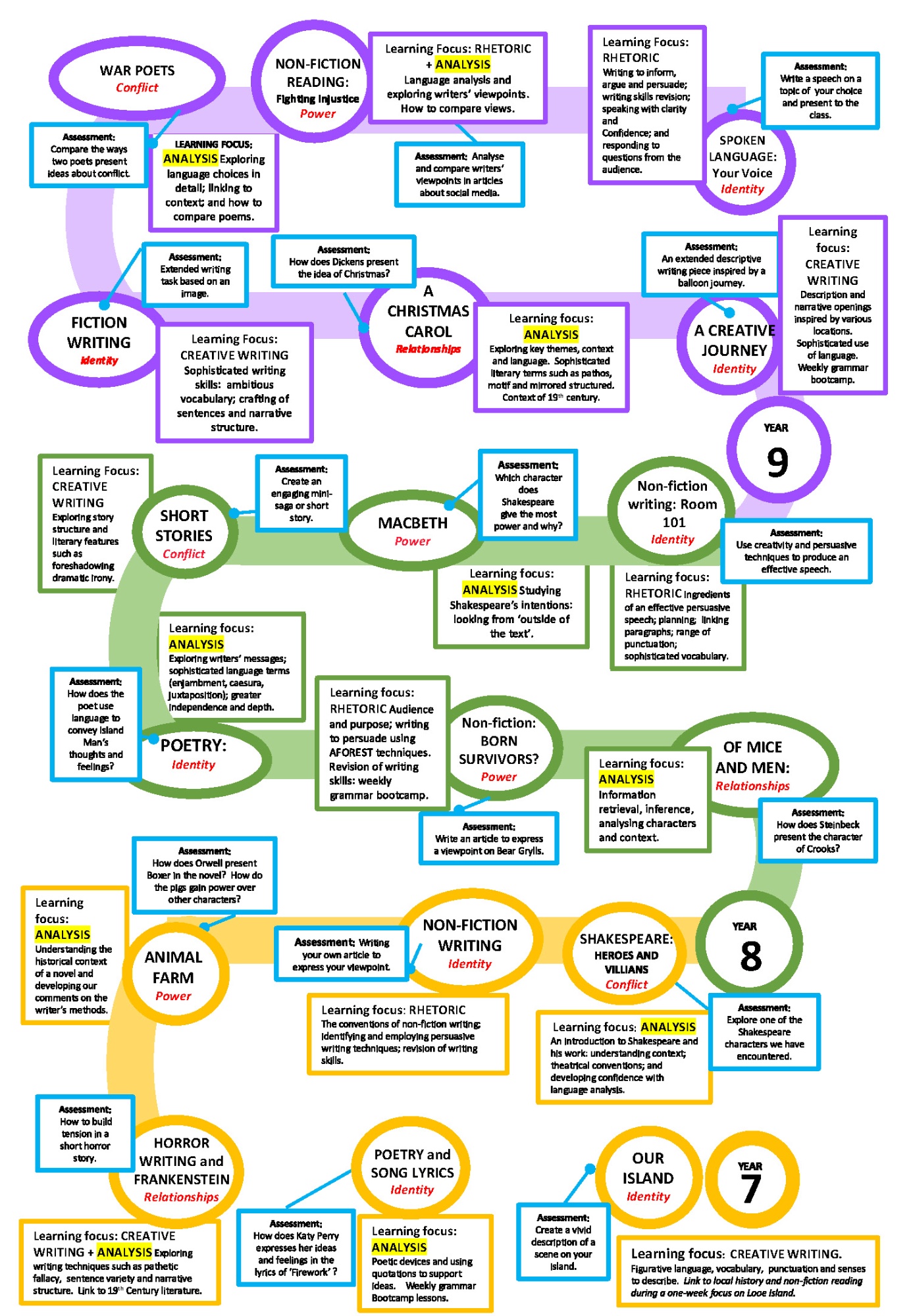
Central to our curriculum are the big ideas of Conflict, Identity, Power, and Relationships. These concepts underpin the texts we study and the discussions we foster, helping students to explore how writers present human experiences and societal issues across time and culture. Through these lenses, learners develop empathy, critical thinking, and the ability to interpret complex perspectives.
We aim to provide high challenge with low threat, creating a culture where students feel safe to take intellectual risks, explore big ideas, and develop their own voice. Through rich encounters with classic and contemporary texts—from Shakespeare’s timeless explorations of ambition and morality to modern narratives of resilience and identity—students learn to question, interpret, and articulate with confidence.
Our curriculum prioritises reading for pleasure, writing for purpose, and speaking for impact. We teach the craft of language and structure while fostering curiosity and creativity through diverse perspectives. Students are encouraged to ask questions, make connections, and express themselves with clarity and originality, preparing them for life beyond the classroom.
Ultimately, our intent is to ignite a lifelong love of language, equipping students with the skills, knowledge, and curiosity to thrive as thoughtful readers, skilled communicators, and imaginative creators in an ever-changing world.
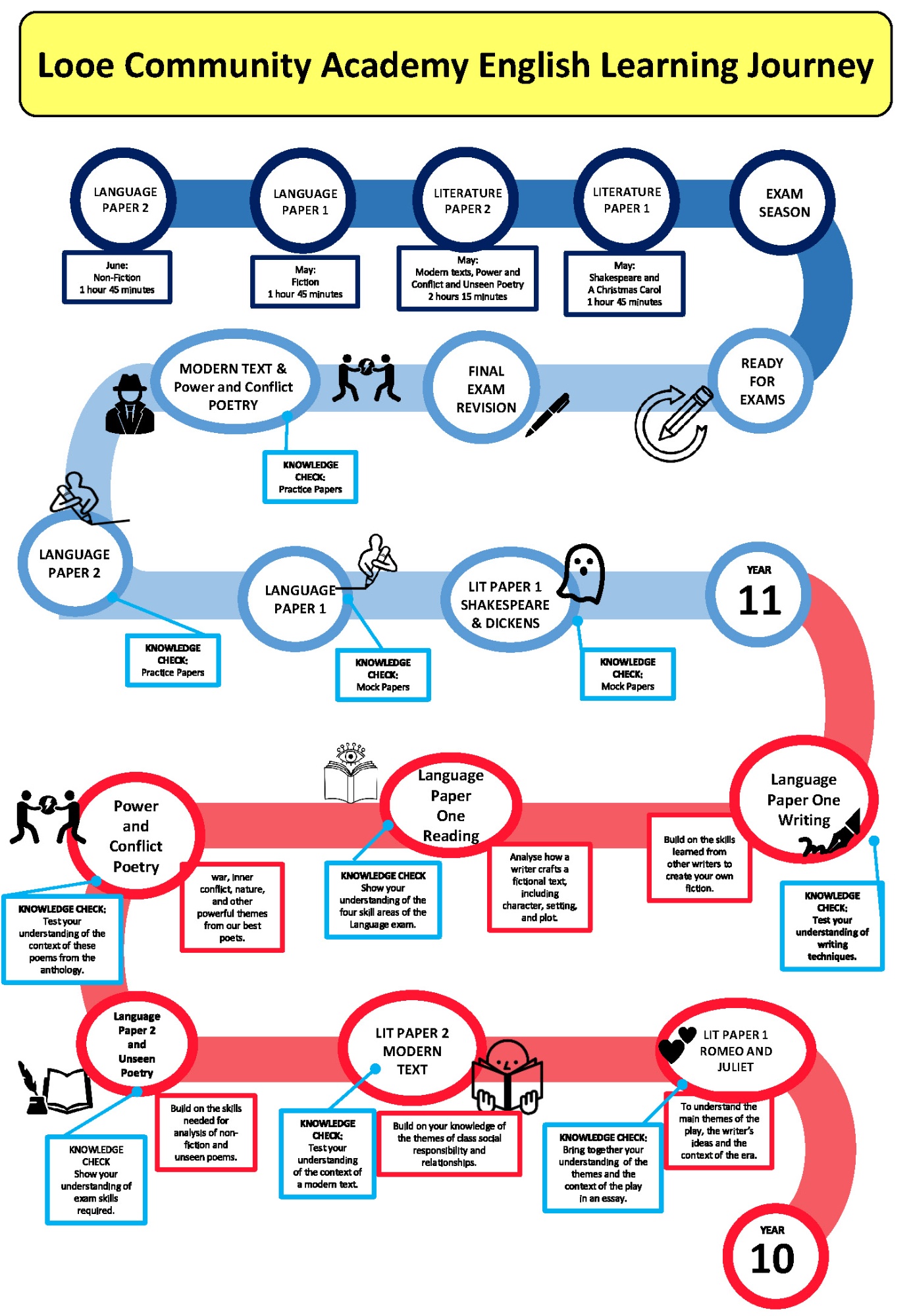
Curriculum Pathways


Focused Curriculum Contextual Routines
- Reading / close
- Frayer Model
- Visualiser
- Think out loud
- Cold Calling
Additional Opportunities Beyond the Classroom
- Reading – All in
- Tutor reads Fiction – autobiography
- Looe Literacy Festival
- Published poetry and competitions
- Published books
- Author visits
Oracy
Speech is power: speech is to persuade, to convert, to compel.
– Ralph Waldo Emerson
Oracy Curriculum Intent
At Looe Community Academy, our Oracy curriculum is designed to transform the way students think, learn, and communicate. We believe that spoken language is not just a skill—it is a gateway to academic success, personal confidence, and active citizenship. Our curriculum empowers learners to become articulate, persuasive, and reflective speakers who can thrive in education and beyond.
Central to our approach are the principles of The Great Oracy Toolkit, which emphasises structured talk, purposeful dialogue, and the development of cognitive, social, and linguistic skills. Oracy is embedded as a discrete subject once a fortnight from years 7 – 9 and is also taught explicitly through lessons that prioritise thinking aloud, reasoning, and collaborative problem-solving. Students learn to listen actively, question critically, and express ideas with clarity and confidence.
We aim to provide high challenge with low threat, creating a culture where every voice matters and students feel safe to take intellectual risks. Through debate, discussion, and dialogic teaching, learners become game-changers and positive disruptors—able to challenge ideas respectfully, influence others, and lead change. They develop the ability to construct arguments, justify opinions, and adapt language for different audiences and purposes.
Our curriculum prioritises academic depth and real-world relevance. Students explore oracy as a tool for learning and leadership, engaging with contemporary issues, ethical dilemmas, and global perspectives. They learn the language of reasoning, negotiation, and empathy, preparing them for success in examinations, interviews, and professional life.
Structure of an Oracy Lesson (Based on Dr Laure Kerslake’s Research)
Each lesson follows a clear, research-informed structure:
- Activate – Introduce the focus skill (e.g., reasoning, turn-taking) and model high-quality talk.
- Rehearse – Students practise through structured activities such as paired discussion, role-play, or exploratory talk.
- Perform – Apply skills in a purposeful context (e.g., debate, presentation, group problem-solving).
- Reflect – Evaluate the quality of talk using agreed success criteria, peer feedback, and self-assessment.
- Extend – Link oracy skills to written outcomes or cross-curricular applications.
This structure ensures progression from supported practice to independent mastery, underpinned by cognitive challenge and metacognitive reflection.
Why Oracy Matters
Research shows that oracy improves:
- Academic attainment through deeper reasoning and vocabulary development.
- Social mobility by building confidence for interviews and public speaking.
- Wellbeing by fostering self-expression and resilience.
- Citizenship by enabling students to participate in democratic dialogue and challenge injustice.
Ultimately, our intent is to create a generation of articulate, confident, and compassionate communicators—students who can think critically, speak powerfully, and lead positively in an ever-changing world.
Focused Curriculum Contextual Routines
- Turn and Talk
- Say it again but better
- Oracy stems
- Rate Line
Additional Opportunities Beyond the Classroom
- Dr Laura Kerslake Researcher for The Chartered College of Teaching and Learning
- Dr Jim Rogers The Great Oracy Toolkit Mercian Trust
- Cross curriculum links with English and Drama
- Philosophical topics to wider curriculum connected topics for debate