
Ofsted
Inspection Report: 10 February 2026
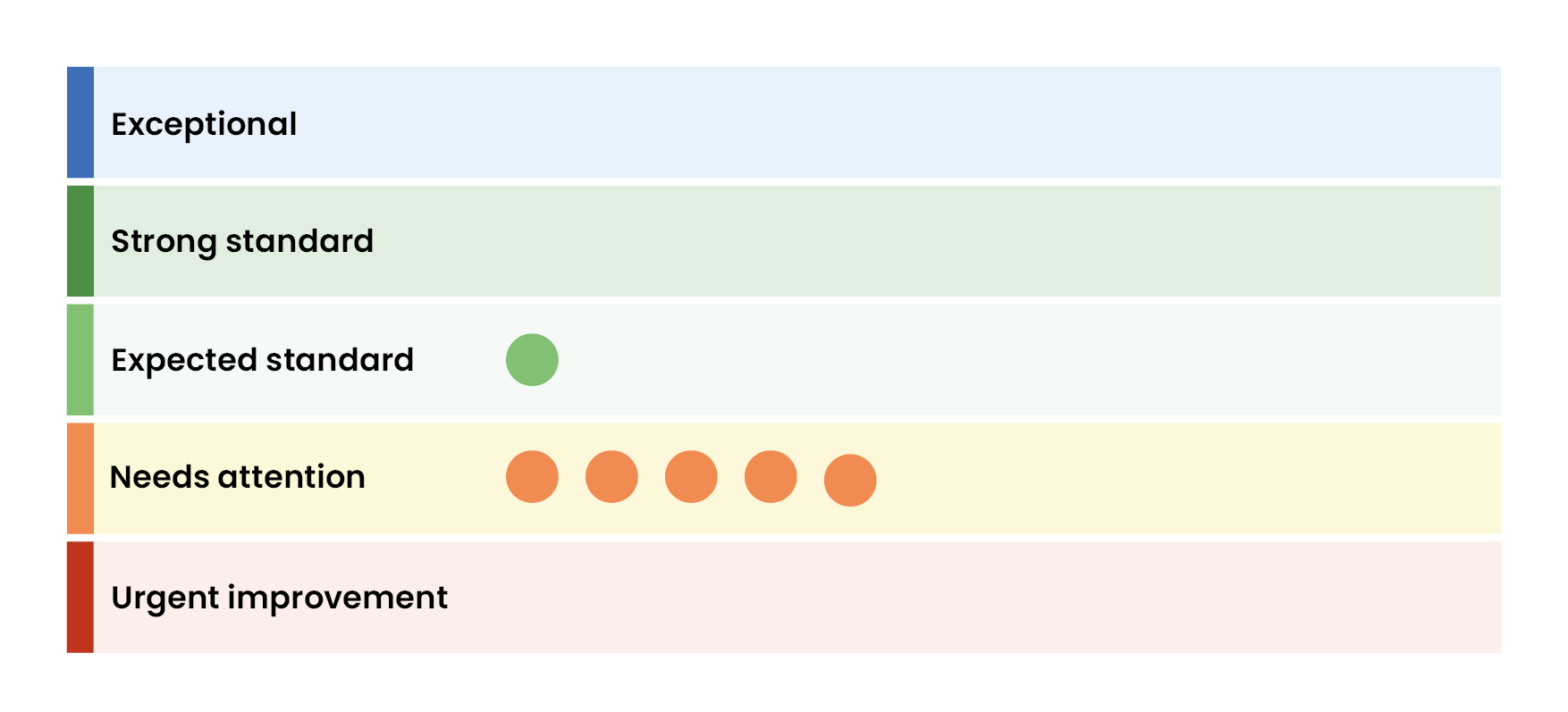
Grades explained
Exceptional
Practice is exceptional: of the highest standard nationally. Other schools can learn from it.
Strong standard
The school reaches a strong standard. Leaders are working above the standard expected of them.
Expected standard
The school is fulfilling the expected standard of education and/or care. This means they are following the standard set out in statutory and non‑statutory legislation and the professional standards expected of them.
Needs attention
The expected standards are not met but leaders are likely able to make the necessary improvements.
Urgent improvement
The school needs to make urgent improvements to provide the expected standard of education and/or care.
Safeguarding standards met
The safeguarding standards are met. This means that leaders and/or those responsible for governance and oversight fulfil their specific responsibilities and have established an open culture in which safeguarding is everyone's responsibility and concerns are actively identified, acted upon and managed. As a result, pupils are made safer and feel safe.
Expected standard
Personal development and wellbeing
The school provides a coherent and well‑structured programme that promotes pupils' wider development. The curriculum develops pupils’ understanding of modern Britain. Pupils learn through a well‑considered relationships, sex and health education programme that helps them understand how to stay safe and make informed choices. For instance, pupils learn how to keep themselves safe when online. They also deepen their understanding of democracy, free speech and the rule of law. This is done through curriculum and practical experiences, such as elections to the school council and opportunities to contribute to the town council.
Pupils benefit from a broad range of enrichment opportunities that extend their experiences and nurture their interests in areas such as the arts, music and sport. They engage with the local community through initiatives, such as community art projects on the seafront and events that celebrate their Cornish heritage. Visits to places of worship, such as mosques, broaden pupils’ understanding of different faiths and strengthen their appreciation of cultural and religious diversity. There is a well‑planned careers programme that prepares pupils for their next steps beyond school. Pupils benefit from effective pastoral support that prioritises their emotional well‑being.
Leaders ensure that all pupils benefit from the personal development offer. They track pupils' participation carefully and take purposeful steps to ensure that disadvantaged pupils and pupils with special educational needs and/or disabilities engage fully. Staff make reasonable adjustments where needed so that pupils can access the full range of opportunities, including visits to universities and theatres.
Overall, the personal development programme is thoughtfully designed and effective. It promotes pupils’ wider development well and reflects leaders’ commitment to provide every pupil with a rich, inclusive and outward‑looking set of experiences.
Needs attention
Achievement
A significant minority of pupils continue to have gaps in their knowledge which limits the progress they make. Leaders’ actions have not secured the sustained improvements in achievement that are needed. Over time, pupils, including disadvantaged pupils, have not attained well in several subjects, leaving some unprepared for their next steps. For example, outcomes at the end of key stage 4 have been below the national standard for some time. Weaknesses in reading and writing are not addressed effectively which means that some pupils struggle to learn with confidence. Staff do not adapt teaching consistently well enough to meet pupils’ needs, meaning a significant minority do not achieve well from their starting points.
Leaders are taking appropriate and well-planned action, and early signs of improvement are emerging. Outcomes have improved in some subjects. However, leaders' work is at an early stage of implementation so the impact of this is not yet widespread.
Attendance and behaviour
Leaders’ work to improve pupils’ attendance has not yet had the intended impact. Overall attendance rates are consistently below the national average. This is also the case for disadvantaged pupils and those with special educational needs and/or disabilities (SEND). This is because the bespoke strategies which leaders have introduced are still in their infancy. A minority of pupils are also not punctual to lessons, which disrupts learning and limits their engagement.
Although leaders identify the academic, social and emotional needs of disadvantaged pupils, pupils with SEND and those known to children’s social care, the support provided has not led to sustained improvements. Staff do not consistently match or implement support to meet pupils’ changing circumstances. This means that too many pupils continue to face barriers that affect their learning.
Leaders have clear ambitions to improve pupils’ behaviour and attitudes. They have introduced a range of appropriate strategies to address social and emotional barriers. Most pupils conduct themselves well, are polite and respond positively to leaders' expectations. Pupils learn in calm, well‑ordered classrooms and generally show positive attitudes to learning. The school deals quickly and consistently with any discrimination or unkind behaviour. Staff know, support and care for pupils well, creating a safe and nurturing environment.
Curriculum and teaching
Leaders’ work to improve the curriculum and the quality of teaching is not yet consistent or embedded. As a result, weaknesses in teaching continue to limit the progress that many pupils make. Staff's use of agreed approaches to teach the curriculum are applied unevenly. For example, staff do not routinely identify or address gaps in pupils’ knowledge with sufficient precision. Leaders have considered how teaching should be adapted for disadvantaged pupils, those with special educational needs and/or disabilities and others who face barriers. However, these adaptations are not consistently well matched to pupils’ needs. Staff sometimes do not have the expertise or confidence to make adjustments accordingly. This means that some pupils do not receive the support they need to follow the curriculum successfully.
Leaders have set clear and suitable ambitions to improve the curriculum and the teaching of it. They have taken early steps to strengthen practice across the school. Their work demonstrates a genuine commitment to raising standards. They have introduced a programme of training for staff, designed to improve the quality of education pupils receive in all subjects. Leaders have also rightly prioritised the development of pupils’ early reading as a key foundation for learning. An effective phonics programme is in place for a small group of pupils.
Overall, leaders’ intentions are positive and well judged, but the early stage of implementation means the impact of their work is not yet evident.
Inclusion
The systems that leaders have in place to identify and support pupils' needs are not yet fully effective. Staff do not use the information they have about gaps in pupils’ knowledge in reading and writing well enough to support learning, particularly for pupils with special educational needs and/or disabilities (SEND). For example, staff do not routinely use information about pupils’ reading skills to help all pupils follow the wider curriculum. As a result, these pupils do not achieve as well as they should.
Leaders have established some systems for identifying pupils’ needs and ensuring that staff use these. For example, seating plans highlight vulnerable pupils. Leaders also endeavour to work closely with families and other professionals to secure the best support for pupils with SEND and disadvantaged pupils. In addition, staff receive a breadth of training on how to support disadvantaged pupils and those with SEND. Leaders use pupil premium funding appropriately to reduce the barriers for disadvantaged pupils. However, this work is still developing and it is too early to see its full impact. Leaders monitor whether their actions are working as they intend but this process, too, is in its infancy.
Leadership and governance
Leaders’ ambitious vision has not yet translated into the consistent, day‑to‑day improvements that pupils need. The initiatives they have introduced are at an early stage and staff do not apply them with the depth or consistency required. As a result, leaders’ changes have not yet secured sustained improvements in classroom practice or pupil outcomes. Expectations of what pupils can achieve vary too widely between staff. This weakens leaders’ strategic direction and slows the pace of improvement.
Although leaders articulate a clear and ambitious vision for the school, this has not produced the coherent, whole‑school impact needed for pupils to benefit fully. Leaders have a clear improvement programme that targets key priorities, including to strengthen attendance, refine the curriculum and improve the quality of teaching. They prioritise removing barriers to learning, particularly for vulnerable and disadvantaged pupils. Leaders also support staff's wellbeing and workload appropriately. This helps staff to feel valued and able to focus on improving their practice.
Trustees and governors provide appropriate challenge and hold leaders to account effectively. However, the impact of their work is also not evident in sustained improvements across the school.
Most parents and carers recognise and value the improvements which have begun to take place. Staff welcome the increased opportunities to develop their practice. However, these positive signs have not yet resulted in the school‑wide consistency required.
Overall, leaders, trustees and governors have established the right foundations for improvement and demonstrate a secure understanding of the school’s needs. Leaders' work is focused on embedding newly implemented systems, expectations and practice so that pupils are able to achieve well.
What it's like to be a pupil at this school
Pupils are personable, polite and generally demonstrate kindness towards one another. They typically display positive attitudes and describe the learning environment as increasingly more purposeful. Pupils develop a palpable sense of belonging through the school’s celebration of its Cornish heritage, which contributes positively to their personal development. Many pupils are positive about the recent changes that leaders have made to the curriculum and to the quality of teaching. While the direction of travel is positive, it is the case that pupils' learning does not yet benefit fully from the actions that leaders have taken.
Consequently, many pupils have gaps in their knowledge, including weaknesses in reading and writing. As a result, pupils do not achieve as well as they should in many subjects. Disadvantaged pupils and pupils with special educational needs and/or disabilities (SEND) do not consistently receive the support they need to enable them to learn with confidence and success. Some pupils, particularly disadvantaged pupils and those with SEND, do not attend regularly. Their absence leads to gaps in knowledge, which limits their progress and means they do not achieve as well as they should.
Pupils have a sense of physical and emotional safety in school. They know that there are trusted adults they can speak to and they feel confident that concerns will be taken seriously. Bullying is not a widespread issue. When it does occur, leaders act swiftly and effectively to resolve it. Pupils benefit from a school environment that is safe, supportive and increasingly responsive to their needs.
Overall, leaders’ intentions are clear and well judged. However, as much of their work is at an early stage, the impact that leaders intend is not being realised in all aspects of school life.
Next steps
- Leaders should embed their curriculum and teaching expectations consistently across the school so that all staff implement agreed approaches to literacy, assessment and the teaching of the curriculum with fidelity.
- Leaders should strengthen staff expertise to better adapt teaching for disadvantaged pupils and those with special educational needs and/or disabilities (SEND), to ensure that adjustments are well matched to pupils’ needs and support them to follow the curriculum successfully.
- Leaders should improve the consistency and quality of teaching so that gaps in pupils’ knowledge are accurately identified and addressed, enabling pupils to build secure foundations for future learning.
- Leaders should ensure that early reading remains a sustained priority and that all staff have the knowledge and confidence to deliver the school’s chosen approach effectively.
- Leaders should improve the attendance of all pupils, particularly pupils with SEND and disadvantaged pupils, so that they are regularly present at school and able to benefit from the full curriculum.
About this inspection
This school is part of the South East Cornwall Multi Academy Trust, which means other people in the trust also have responsibility for running the school. The trust is run by the chief executive officer, Dan Buckley, and overseen by a board of trustees, chaired by Jamie Crisp.
Inspectors carried out this full inspection under section 5 of the Education Act 2005.
Following our renewed inspection framework, all inspections are now led by His Majesty’s Inspectors (HMIs) or by Ofsted Inspectors (OIs) who have previously served as HMIs.
Inspectors spoke with the headteacher, deputy headteacher and other members of the senior leadership team, including the special educational needs coordinator. They also held discussions with a representative of the trust board and the governing body, the chief executive officer and the director of education at the trust. Inspectors held discussions with teachers, support staff and pupils during the inspection.
The school meets the requirements of the provider access legislation, which requires schools to provide pupils in Years 8 to 13 with information and engagement about approved technical education qualifications and apprenticeships.
The inspectors confirmed the following information about the school:
The school makes use of 2 alternative provisions, including one that is unregistered.
Headteacher: Paul Boyes
Further information and facts and figures used on inspection can be found below:
For previous reports visit: Ofsted | Looe Community Academy